
Opening your own pharmacy in the UK is a significant entrepreneurial step that combines healthcare passion with strong business planning. Whether you are a qualified pharmacist seeking independence or an investor entering the healthcare sector, starting pharmacy business in the UK requires careful financial planning, regulatory compliance, and strategic decision-making.
With the UK’s ageing population and the expanding role of community pharmacies in delivering clinical services such as vaccinations and health checks, 2026 presents real opportunities for aspiring pharmacy owners. However, the financial reality is important to understand: you may need between £250,000 and over £1 million in startup capital, depending on whether you are building a pharmacy from scratch or acquiring an existing business.
This comprehensive guide walks you through the complete financial setup process for starting a pharmacy business, from initial investment and funding options to business structure, VAT, tax planning, and ongoing operational costs. It will help you make informed decisions about one of the most rewarding yet challenging ventures in the UK healthcare sector.
Understanding the Two Pathways: Build or Buy
Before diving into financial specifics, you must decide between two fundamentally different approaches, each with distinct financial implications.
Building a New Pharmacy (Greenfield)
Starting from scratch allows complete control over location, layout, branding, and operational systems. The upfront application costs are relatively modest approximately £1,500 for NHS contract and General Pharmaceutical Council (GPhC) premises registration fees, plus potential planning permission costs.
However, the total capital requirement for a greenfield pharmacy typically ranges from £250,000 to £400,000, covering:
- Premises lease deposits and initial rent
- Complete fit-out and pharmacy-specific infrastructure
- Dispensing equipment and technology systems
- Initial inventory (approximately £90,000)
- Working capital to sustain operations for 7-14 months until breakeven
The major advantage is customization and potentially lower purchase price. The significant disadvantage is time NHS pharmaceutical list applications can take four months or longer, with no guaranteed approval, and GPhC premises registration adds another three months. You’ll also start with zero patient base and unknown cash flow.
Acquiring an Existing Pharmacy
Purchasing an established pharmacy means inheriting an operational business with existing patient relationships, predictable revenue streams, and immediate cash flow. However, expect to budget at least £1 million plus legal costs (approximately £6,000-£7,000).
Pharmacy valuations typically range from £1.50 to £2.00 for every pound of turnover, with premium locations commanding higher multiples. Key financial metrics include EBITDA (earnings before interest, tax, depreciation, and amortisation), which reveals true profitability after accounting for loans and asset depreciation.
Established pharmacies come with staff, equipment, premises (lease or freehold), and stock, significantly reducing your post-purchase setup burden. The drawback is the substantial upfront capital requirement and potential need to rebrand, retrain staff, and update systems to match your vision. Working with specialist pharmacy accountants during due diligence is essential to verify financial health and identify hidden liabilities.
Choosing Your Business Structure
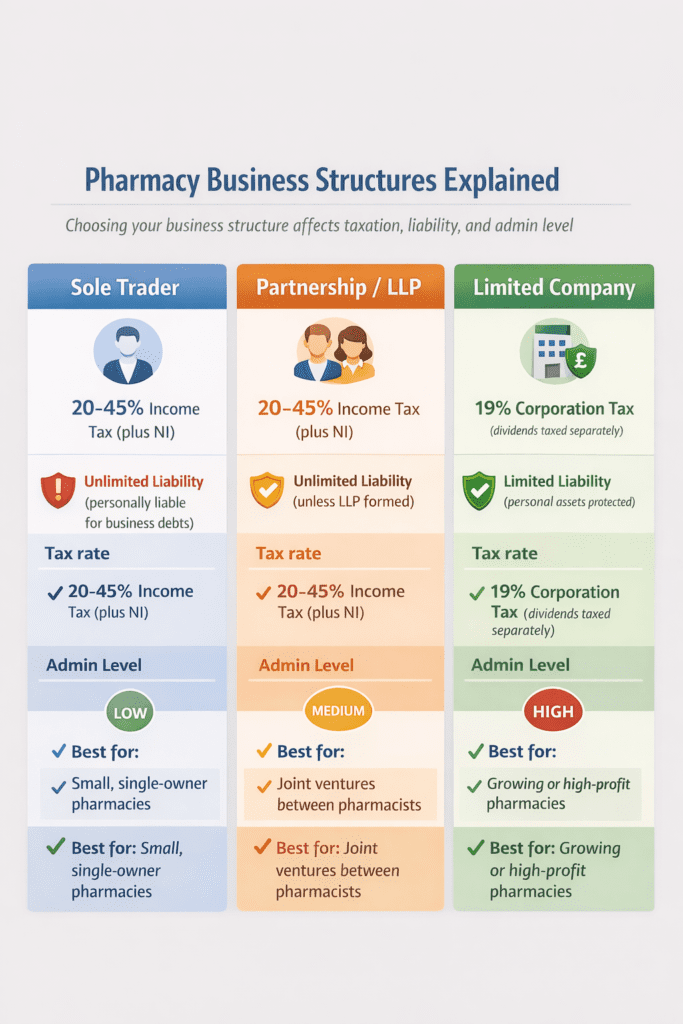
Your legal structure profoundly impacts taxation, liability, and administrative obligations. The three main options each suit different circumstances.
Sole Trader
Operating as a sole trader means you and your business are legally one entity. This structure is simplest administratively, with straightforward personal tax reporting through Self Assessment. However, you have unlimited personal liability for business debts, and all profits are subject to income tax at potentially 40-45% for higher earners, plus Class 2 and Class 4 National Insurance contributions.
Partnership
If starting with other pharmacists, a partnership allows shared investment and expertise. Each partner reports their share of profits through Self Assessment, and the partnership itself files an annual return. Like sole traders, partners have unlimited liability unless structured as a Limited Liability Partnership (LLP), which offers personal asset protection while maintaining tax transparency.
Limited Company
Many pharmacy owners choose limited company structures for tax efficiency and liability protection. The company pays Corporation Tax at 19% on profits (for profits up to £50,000), with shareholders extracting income through salary and dividends.
For example, a pharmacy generating £100,000 in annual profit could structure owner remuneration as:
- Salary: £12,570 (up to personal allowance, no income tax)
- Dividends: £87,430 (after Corporation Tax)
Total tax liability would be approximately £19,000 in Corporation Tax plus £13,729 in dividend tax—total £32,729, compared to approximately £36,000 as a sole trader, saving roughly £3,300 annually.
However, limited companies require more administration: annual accounts, Corporation Tax returns, and—if you’re a superintendent pharmacist—careful compliance with GPhC requirements. The regulations require either a pharmacist owner or a board-appointed superintendent pharmacist with appropriate authority. Our business tax specialists can help you structure your company tax-efficiently while meeting all regulatory requirements.
Initial Capital Expenditure Breakdown
Understanding where your startup capital goes is crucial for accurate budgeting and securing financing.
Premises Costs (£50,000-£300,000+)
Location determines your success. High-street locations near GP surgeries, medical centres, or residential areas with aging demographics typically command premium rents but deliver higher footfall. Budget for:
- Lease deposit: 3-6 months’ rent upfront
- Monthly rent: £3,000-£10,000 depending on location (London significantly higher)
- Fit-out and renovation: £45,000-£75,000 for shelving, dispensing area, consultation rooms, security systems, and pharmacy-specific infrastructure
- Signage and branding: £5,000-£10,000
Ensure premises meet GPhC standards and local planning requirements for pharmacy use, which may require change-of-use applications.
Equipment and Technology (£60,000-£90,000)
A modern pharmacy requires sophisticated equipment:
- Dispensing equipment: £20,000-£30,000 (automated dispensing systems, counting machines, refrigeration for cold-chain medicines)
- Pharmacy management software: £10,000-£15,000 (initial licenses for systems integrated with NHS Electronic Prescription Service and patient medication records)
- Computer hardware and point-of-sale systems: £8,000-£12,000
- Security systems and CCTV: £5,000-£8,000 (essential for controlled drugs compliance)
- Consultation room equipment: £3,000-£5,000
- Office furniture and fixtures: £5,000-£10,000
Initial Inventory (£90,000-£120,000)
Stock represents your largest single non-fixed cost. Pharmaceutical wholesalers typically help new pharmacies establish standard prescription medication inventories based on pharmacy size and local demographics. You’ll need:
- Prescription medicines: £70,000-£90,000
- Over-the-counter medicines and health products: £15,000-£25,000
- Medical supplies and pharmacy consumables: £5,000
Inventory financing options exist through wholesaler agreements, allowing you to defer payment for 30-90 days, improving initial cash flow.
Licenses, Registrations, and Professional Fees (£15,000-£25,000)
Regulatory compliance requires multiple registrations:
- GPhC pharmacy premises registration: £293 annually (increased from £269 in September 2025)
- NHS pharmaceutical list application: Approximately £750
- Controlled Drugs license (Home Office): £326 for three years
- Business licenses and permits: £500-£1,000
- Professional indemnity insurance: £2,000-£4,000 annually
- Public liability and employer’s liability insurance: £3,000-£5,000 annually
- Legal fees for lease negotiations and contracts: £3,000-£5,000
- Accounting and financial advisory fees: £2,000-£5,000 for setup and first-year support
Specialist healthcare accountants familiar with pharmacy sector regulations ensure you meet all compliance requirements while optimizing your financial structure.
Ongoing Operational Costs
After launch, monthly operational expenses determine your cash flow sustainability. Budget conservatively for the first 12-18 months while building patient numbers.
Fixed Overhead (£11,650+ monthly)
- Premises rent: £3,000-£10,000
- Utilities (electricity, water, heating): £1,000-£1,500
- Business rates: £500-£2,000 (depending on rateable value)
- Internet, phone, and software subscriptions: £300-£500
- Insurance renewals (monthly allocation): £400-£750
- Security and maintenance: £200-£400
- Professional subscriptions and licenses: £100-£200
Payroll Costs (£19,375+ monthly for initial team)
Staffing represents your largest ongoing expense. According to GPhC requirements, dispensing up to 4,999 items requires only 56 pharmacist hours, but competitive pharmacies typically need:
- Pharmacist-in-Charge (superintendent pharmacist): £3,500-£5,000 monthly
- Additional pharmacist(s) for extended hours: £3,000-£4,500 each
- Pharmacy technicians (2-3 staff): £2,200-£2,800 each
- Pharmacy assistants/counter staff (2-3 staff): £1,800-£2,200 each
Employer National Insurance and pension auto-enrolment add approximately 15-20% to gross payroll costs. The National Living Wage increased in April 2025, and pharmacies across England face approximately £159 million in additional wage costs in 2026, according to the National Pharmacy Association. Our payroll for healthcare services ensure full compliance with PAYE, auto-enrolment, and Making Tax Digital requirements.
Variable Costs
- Inventory replenishment (Cost of Goods Sold): Approximately 100% of prescription revenue goes to wholesalers for stock
- Pharmacy Benefit Manager (PBM) and Direct and Indirect Remuneration (DIR) fees: Approximately 40% of revenue
- Marketing and advertising: £500-£2,000 monthly initially
- Merchant services and banking fees: £200-£500
- Waste disposal and pharmaceutical returns: £100-£300
Financing Your Pharmacy: Funding Sources
Few aspiring pharmacy owners have £250,000-£1,000,000 in personal savings, making external financing essential.
Bank Loans
Traditional high-street banks remain the most common financing source. To secure a pharmacy business loan:
- Prepare a comprehensive business plan with 3-5 year financial projections
- Demonstrate relevant experience (pharmacy qualification and management experience)
- Provide 20-30% deposit from personal funds or equity
- Expect loan terms of 5-15 years with interest rates currently 6-9%
Banks conduct rigorous due diligence, requiring detailed cash flow forecasts, market analysis, and personal guarantees.
Secured vs. Unsecured Loans
Secured loans use business or personal assets (property, equipment) as collateral, offering larger amounts (£50,000-£500,000+) at lower interest rates. However, defaulting means losing your collateral.
Unsecured loans don’t require collateral but demand personal guarantees, involve smaller amounts (typically £25,000-£100,000), and charge higher interest rates to compensate for lender risk.
Wholesaler Financing
Major pharmaceutical wholesalers offer specialized pharmacy financing programs, including:
- Inventory financing with extended payment terms
- Equipment leasing arrangements
- Business startup packages with deferred repayments
These arrangements often integrate inventory management with financing, simplifying administration.
Partnership and Equity Investment
Sharing ownership with other pharmacists or healthcare investors reduces individual capital requirements. Each partner contributes a portion of startup costs, potentially lowering loan amounts and interest payments. However, shared ownership means shared decision-making and profit distribution.
Small Business Administration (SBA) Loans (or UK Equivalents)
Government-backed loan schemes can provide favorable terms for qualifying businesses. In the UK, the British Business Bank’s various schemes offer partial government guarantees to lenders, reducing their risk and improving your access to capital.
Regardless of financing source, working with experienced accountants who understand pharmacy business economics strengthens your application and ensures sustainable debt servicing.
VAT Considerations for Pharmacies
Value Added Tax (VAT) creates unique complexities for pharmacies due to mixed supplies.
Most prescription medicines dispensed under NHS contracts are exempt from VAT. However, over-the-counter medicines, cosmetics, and non-healthcare retail items are standard-rated at 20%, while some healthcare products may be zero-rated.
This mixed supply position often places pharmacies in partial exemption, requiring complex VAT calculations to determine recoverable input tax on business expenses. Our VAT specialists help pharmacy owners:
- Navigate partial exemption rules
- Optimize VAT recovery on capital expenditures
- Ensure compliant VAT returns
- Prepare for Making Tax Digital for VAT submissions
If your taxable (standard-rated and zero-rated) supplies exceed £90,000 annually, you must register for VAT and submit returns—monthly or quarterly depending on turnover.
Cash Flow Management: The First 12 Months
The critical financial challenge for new pharmacies is maintaining adequate cash flow during the first 12-18 months while building patient numbers and establishing NHS payment rhythms.
Breakeven Timeline
Financial modeling suggests new pharmacies typically require 7-14 months to reach breakeven, depending on location, competition, and services offered. During this period, you’re consuming cash:
- Minimum cash requirement: £647,000 to cover all startup costs and operational losses until July 2026 breakeven (for a January 2026 launch)
- Monthly burn rate: £27,000-£39,000 before meaningful revenue
Strategies for Cash Flow Optimization
- Negotiate favorable payment terms with wholesalers (aim for 60-90 day terms initially)
- Diversify revenue streams beyond dispensing: vaccinations (15% of sales mix), health checks, minor ailment schemes, and specialized services generate higher margins
- Monitor NHS payment cycles closely—most NHS payments process monthly, but delays can occur
- Maintain a cash reserve of 3-6 months’ operating expenses
- Implement robust credit control for private prescriptions and care home accounts
- Set up a revolving line of credit (£25,000-£50,000) for inventory purchasing flexibility
Professional bookkeeping for healthcare businesses ensures real-time visibility of your cash position, helping you make informed decisions about inventory purchases, staffing levels, and growth investments.
Key Performance Indicators to Monitor
Successful pharmacy owners track specific financial metrics:
Revenue Metrics
- Items dispensed per day (target: 100-150 for sustainability)
- Average prescription value
- OTC sales as percentage of total revenue
- Private vs. NHS prescription mix
Profitability Metrics
- Gross profit margin (after COGS and PBM fees)
- EBITDA margin
- Net profit margin
- Return on equity (ROE)
Operational Efficiency
- Cost per item dispensed
- Staff productivity (items per pharmacist hour)
- Stock turnover rates
- Waste and returns as percentage of purchases
Regular reviews with your accountant help identify improvement opportunities and ensure you’re on track to meet financial projections.
Tax Planning for Pharmacy Owners
Strategic tax planning significantly impacts your take-home income.
Corporation Tax Optimization
If operating as a limited company, time major equipment purchases and expenses strategically. Annual Investment Allowance (AIA) allows 100% tax relief on qualifying equipment up to £1 million in the year of purchase, reducing taxable profits.
Personal Tax Efficiency
Combine salary (up to personal allowance of £12,570 in 2026/27) with dividend distributions to minimize total tax liability. Consider pension contributions for additional tax relief—employer pension contributions are deductible business expenses and provide employees with tax-efficient retirement savings.
VAT Planning
Review your VAT partial exemption annually. Changes in your sales mix (more private OTC sales vs. NHS prescriptions) can significantly impact recoverable input VAT.
Research and Development (R&D) Tax Credits
If your pharmacy develops innovative services, compounding processes, or digital health solutions, you may qualify for R&D tax credits offering substantial tax relief.
Conclusion
Starting your own pharmacy in 2026 represents a substantial financial commitment but offers rewarding professional independence and the opportunity to serve your community directly. Whether you need £250,000 for a greenfield startup or £1 million+ to acquire an established business, thorough financial planning is essential.
Key success factors include:
- Choosing the optimal business structure for your circumstances
- Securing adequate financing with manageable debt servicing
- Maintaining 12-18 months of cash reserves
- Implementing robust financial controls and KPI monitoring
- Working with specialist healthcare accountants who understand pharmacy economics
At Kudos Accounting, we specialize in helping pharmacists and healthcare professionals navigate the complex financial landscape of starting and growing pharmacy businesses. With over 20 years of experience serving the healthcare sector, our team provides tailored guidance on business structure, tax planning, VAT compliance, and ongoing financial management.
Ready to start your pharmacy ownership journey? Contact Kudos Accounting today for a free consultation and discover how we can help you build a financially sound, sustainable pharmacy business.
Frequently Asked Questions (FAQs)
You should expect to need approximately £250,000–£400,000 to build a new pharmacy from scratch, or £1 million+ to purchase an existing pharmacy. This includes premises costs, equipment, initial stock, licences, and sufficient working capital to cover 7–14 months of operating costs before breakeven. The exact amount depends on location, size, and whether you are buying an established business or starting fresh.
Limited companies are generally more tax-efficient for pharmacies generating £50,000+ annual profit, with Corporation Tax at 19% on lower profits compared to income tax rates of 40–45% for higher earners. However, companies involve more administration and regulatory compliance. The best structure depends on projected profits, liability considerations, and administrative capacity. Specialist pharmacy accountants can model both options for your specific situation.
Not necessarily. While pharmacy premises must be registered with a pharmacist or partnership of pharmacists, you can own a pharmacy through a limited company by appointing a qualified superintendent pharmacist. The superintendent holds responsibility for pharmaceutical services. Non-pharmacist owners should work closely with legal and regulatory advisers to ensure full GPhC compliance.
NHS pharmaceutical list applications typically take a minimum of four months, but this can extend if there are competing applications or appeals. GPhC premises registration usually adds another three months. Overall, expect a timeline of 7–12 months from application to opening, requiring careful cash-flow planning during the approval period.
Typical monthly operating costs for a community pharmacy range from £31,000–£39,000. This includes rent (£3,000–£10,000), payroll (£19,375+ for pharmacists, technicians, and assistants), utilities and overheads (£2,000–£3,000), plus other fixed expenses. Variable costs such as stock replenishment often equal around 100% of prescription revenue, with PBM fees consuming up to 40% of revenue.
Banks typically require a 20–30% deposit from personal funds or equity. For a £1 million pharmacy purchase, this equates to £200,000–£300,000. Loan terms usually range from 5–15 years with interest rates around 6–9%. Lenders assess your business plan, experience, credit history, and cash-flow forecasts. Some wholesalers also offer pharmacy-specific financing linked to inventory supply.
New pharmacies typically reach breakeven within 7–14 months, depending on location, competition, patient growth, and service mix. Profitability improves as NHS prescription volumes increase and additional services such as vaccinations and clinical services are introduced. Purchased pharmacies are often profitable immediately but may take time to reach their full potential after acquisition.
Pharmacies must register for VAT if taxable supplies exceed £90,000 annually. NHS prescription medicines are VAT-exempt, while over-the-counter products are standard-rated at 20%. This creates partial exemption complexities that affect how much VAT you can reclaim. Specialist VAT accountants help optimise recovery and ensure compliance, particularly under Making Tax Digital rules.